Please Wait transaction is in process, don't refresh page and do not press back button.
We endeavour to help you manage your compliance requirements effectively.

25 lakh tax returns filed

Strategic PARTNERSHIPS

Onboard EXPERTS

Working CITIES

Basic Details Selection
Select the financial year and enter PAN number, business or employer category, and active mobile number.

KYC Information
Provide personal details such as name, father’s name, mobile number, email ID, Aadhaar number, and date of birth.

Communication Address
Enter complete address details including flat or house number, area, road, city, state, and PIN code.

Bank Account Details
Fill in bank-related information like bank name, account number, confirmation of account number, IFSC code, branch name, and account type.

Income Information & Documents
Share income details including gross total income, agricultural income, other income, capital gains, along with required documents such as PAN, Aadhaar, and income proofs.

ITR Filing & Verification Support
Based on the provided details, the income tax return is filed, followed by complete assistance in verifying the ITR to successfully complete the filing process.
 Grow your business with our services
Receive training on all services we provide
Get dedicated support for your partner journey
Grow your business with our services
Receive training on all services we provide
Get dedicated support for your partner journey

Experts help you claim all eligible deductions and exemptions to improve your overall tax outcome.
Proper filing and verification help reduce common mistakes that can slow down return processing.

Income, deductions, and exemptions are reviewed carefully to keep calculations correct and consistent.

Filing requirements and procedural formalities are handled professionally, keeping the entire process smooth and worry-free.

Proper review of details helps reduce the chances of errors and mismatches that may lead to tax notices.

All documents are reviewed and organized properly so complete and accurate information is submitted during filing.
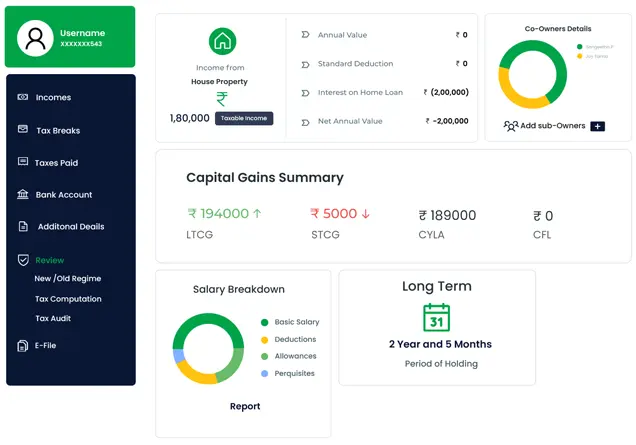

File your income tax return by yourself. It's fast and easy.

We promise to deliver exceptional service. If you are not satisfied with our service, we will provide an unconditional refund of the service fee you paid.
Get Started
File your Income Tax Return using the fastest and safest platform in India. We also offer a wide range of professional services.
 Authorized by Income Tax Department "e-Return Intermediary (ERI)"
 Registered with Startup India is Duly Certified Under Government of India Startup India
Scheme.
Registered with Startup India is Duly Certified Under Government of India Startup India
Scheme.
 Supported by iStart (Government of Rajasthan. Initiative for startups).
 Secure and Safe
 Team of Chartered Accountants
 One Stop Solution for all Your Tax Needs




Click on Get Started button and select just your want by Web Online CA
Get Started Watch Videos

We assist salaried employees, self-employed professionals, and NRIs in filing their ITR accurately, covering income from salaries, capital gains, business profits, and other sources.

Our experts help you plan your taxes efficiently, claim eligible deductions, and stay compliant with the latest Income Tax rules.

We manage tax filing for businesses, including proprietorships, partnerships, and companies, ensuring proper documentation, audits, and compliance.

We keep your personal information, safe and secure. Your privacy is protected across Web Online CA
Web Online CA have expert team, who have expertise in a given domain they have the ability to work
Web Online CA have Extraordinary Skills customer support, customers can get help and find answers to questions real-time.

Your data is securely transmitted using SSL encryption to ensure safe communication and protected access at every stage.

We respect your privacy and do not share your data with third parties, ensuring complete confidentiality and responsible handling.

We follow strong security practices and regular monitoring to maintain high standards of data protection and safety.
We maintain multiple layers of protection to keep your information safe and reduce any risk of misuse.
PAN card
Aadhaar card
Form 16 (for salaried individuals)
Bank statements for interest income
TDS and interest certificates from banks
Form 26AS and Annual Information Statement
Details of investments and expenses for tax deductions
If the return is not filed on time, a late fee may apply and interest can be charged on unpaid tax. Refunds usually take longer in such cases. You can still file the return later, but only within the time allowed by the tax department.
Anyone whose annual income is above the basic exemption limit should file an ITR. For most individuals, this limit is ₹2.5 lakh. In the case of senior citizens aged 60 years or above, the exemption limit is higher, and it increases further for very senior citizens aged 80 years and above.
A Nil Income Tax Return is filed when your total income is below the basic exemption limit and no tax is payable. It notifies the Income Tax Department about your income and ensures your record is up to date.
Form 16 is a certificate issued by an employer to a salaried employee. It shows the total salary paid during the year and the tax deducted from it. This document helps you understand how much tax has already been paid on your behalf.
Form 16 is not compulsory, but it makes ITR filing easier for salaried individuals. If you do not have Form 16, you can still file your return using salary slips and bank statements.
After filing your Income Tax Return, e-verification is required to complete the process. You can e-verify your ITR by logging in to the income tax portal and selecting the option to verify your return. Verification can be done using Aadhaar OTP, net banking, bank or demat account verification.
You can check your ITR status by visiting the income tax portal and entering your PAN and assessment year. The status shows whether your return has been filed, verified, or processed. This helps you track the progress of your return and know if any further action is required.
Filing an Income Tax Return helps maintain a proper record of your income and taxes paid. It allows you to claim refunds if excess tax has been deducted and makes it easier to apply for loans, credit cards, or visas. Regular ITR filing also reduces the chances of tax notices and keeps your financial history clear and up to date.
The Financial Year (FY) is the period in which you earn income, from 1 April to 31 March. The Assessment Year (AY) is the year immediately after the Financial Year, during which your income is assessed and your Income Tax Return is filed.
Once the return is filed and e-verified, refunds are usually processed within a few weeks, depending on the department's verification process.
Yes, you can revise your Income Tax Return if you notice any error or omission in the original filing. The revised return must be submitted within the time limit prescribed under the Income Tax Act.
Common documents include PAN card, Aadhaar card, address proof of business, bank account details, and photographs of the applicant.
GST registration is required when the annual turnover exceeds ₹40 lakh for businesses dealing in goods and ₹20 lakh for service providers. In certain special category states or for specific types of businesses, GST registration may become mandatory at a lower turnover limit as prescribed under GST rules.
Yes, GST registration can be cancelled if the business is discontinued, transferred, or no longer liable for GST.
Yes, GST registration is mandatory for businesses selling goods or services through online platforms, regardless of their turnover. This rule applies even if the business's income is below the standard exemption limit.
A GST return is a statement submitted by a registered taxpayer to report their business activity for a specific period. It shows details of sales made, purchases incurred, GST collected from customers, and tax paid on purchases. Based on this information, the tax department determines the final GST amount payable or refundable.
Yes. Even when there are no sales or purchases during a tax period, a Nil GST return is required to be filed. This ensures continued compliance with GST regulations and helps avoid late fees or other consequences.
Regular filing of GST returns helps businesses claim eligible input tax credit and stay updated with their tax obligations. It also reduces the risk of penalties and interest, provides a clear view of business transactions.
MSME Registration, also called Udyam Registration, is a facility provided by the government for small and medium businesses. It helps businesses get officially recognised as an MSME and makes it easier to access tax benefits, business support schemes, and loan facilities.